
Disclaimer: This article provides general educational information about hospital emergency evacuations and is not professional medical, safety, or consulting advice. Healthcare facilities should consult qualified safety professionals and develop facility-specific evacuation plans with input from clinical staff, fire safety experts, and regulatory authorities.
Case study information is compiled from publicly available sources including news reports, published case studies, and industry publications. Specific details may vary from actual events. References to hospitals and events are for educational purposes only and do not constitute endorsements. Individual facility results vary based on numerous factors including building configuration, staff training, patient populations, and specific scenarios.
Introduction
At 7:30 PM on October 29, 2012, as Hurricane Sandy’s storm surge flooded New York University Langone Medical Center’s basement, staff realized the hospital’s backup generators would soon fail. The NICU housed 20 vulnerable infants—some weighing less than two pounds, many dependent on ventilators and specialized equipment. With elevators lost and stairwells their only option, nurses and doctors faced a decision that would test every aspect of their emergency preparedness planning.
Real-world hospital evacuations reveal truths that drill scenarios cannot fully capture. The psychological stress of actual emergencies, unexpected equipment failures, communication breakdowns under pressure, and split-second decisions affecting patient lives create conditions that even comprehensive training struggles to replicate. Learning from facilities that experienced actual infant evacuations provides insights no amount of theoretical planning can match.
This comprehensive analysis examines documented hospital infant evacuation cases spanning fire emergencies, natural disasters, structural failures, and other scenarios requiring rapid patient movement. We’ll explore what worked, what failed, how facilities adapted when initial plans proved insufficient, and the specific lessons that should inform every hospital’s emergency preparedness planning. These real-world experiences provide evidence-based guidance for improving evacuation procedures, equipment selection, training approaches, and the split-second decision-making that saves lives during actual emergencies.
Case Study 1: Hurricane Sandy and NYU Langone Medical Center NICU Evacuation
Hurricane Sandy’s October 2012 impact on New York City created one of the most documented and studied hospital evacuation cases in modern healthcare history. NYU Langone Medical Center’s experience offers detailed lessons about vertical evacuation, equipment limitations, staffing challenges, and the remarkable coordination required to save vulnerable infants during catastrophic infrastructure failure.
The Situation
As Hurricane Sandy’s storm surge flooded lower Manhattan, NYU Langone Medical Center lost primary power around 8:00 PM. Backup generators in the basement—standard design for this era of construction—soon flooded, cutting all power including elevators. The hospital’s NICU, located on the upper floors, housed 20 infants, with some weighing less than two pounds and many requiring mechanical ventilation.
The combination of lost elevators and ventilator-dependent patients created a crisis scenario rarely encountered in healthcare. Staff faced evacuating the entire NICU down multiple flights of stairs while manually ventilating the most fragile patients throughout the descent. The decision to evacuate came after hours of attempting to preserve generator function, meaning the evacuation began late into the emergency while staff already experienced significant stress and fatigue.
Initial equipment assessment revealed limitations. The hospital maintained evacuation equipment designed primarily for horizontal movement. Most evacuation cribs and transport isolettes lacked features for safe vertical transport. Staff needed to improvise carrying methods, coordinate manual ventilation during movement, and manage oxygen supply for multiple patients simultaneously while navigating dark stairwells illuminated only by flashlights and cell phones.
The Evacuation
The actual evacuation took approximately 4 hours, with staff forming human chains down stairwells. Nurses, physicians, respiratory therapists, and volunteers stationed themselves at intervals through the stairwells, passing infants from person to person down nine flights of stairs. This human chain approach distributed the physical burden while maintaining constant hands-on care for each baby.
Ventilator-dependent infants required continuous manual ventilation using bag-valve masks. Respiratory therapists and nurses rotated responsibility for squeezing the bags that delivered each breath while simultaneously descending stairs. This demanding task required intense concentration—too much pressure could damage fragile lungs, too little would result in inadequate oxygen. Staff maintained this manual ventilation for some infants throughout the entire four-hour ordeal.
Equipment challenges became immediately apparent. Standard transport isolettes proved too heavy and bulky for efficient stairwell navigation. Oxygen tanks required constant monitoring and replacement. IV pumps and monitoring equipment complicated the carrying logistics. Staff adapted by simplifying—disconnecting non-essential monitors, consolidating equipment, and prioritizing life support over comprehensive monitoring during the descent.
Communication proved difficult without reliable power for phones or radios. The stairwells created acoustic challenges making verbal communication between floors nearly impossible. Staff relied on runners carrying messages and updates between floors. This communication lag created uncertainty—did all the babies make it down? Where should we take them next? Are receiving ambulances ready?
Outcomes and Lessons Learned
All 20 infants were successfully evacuated from the NICU. The experience revealed significant gaps in hospital emergency preparedness that have influenced national standards since.
Equipment Limitations Identified:
- Standard isolation prevented efficient vertical transport
- Manual ventilation proved exhausting for staff
- Oxygen supply management created constant concern
- Limited lighting made safe stairwell navigation challenging
Staffing Insights:
- The human chain approach required many more staff members than typical evacuation calculations assumed
- Fatigue became a significant safety concern
- Staff without pediatric training contributed effectively to the physical transport despite lacking specialized clinical knowledge
- Clear role assignments helped organize what could have been chaotic
Planning Gaps Revealed:
- Backup generator placement in flood-vulnerable basements represented flawed infrastructure design
- Evacuation equipment primarily designed for horizontal movement proved insufficient
- Power loss eliminated assumed evacuation tools (elevators, lighting, communication systems)
- Time estimates for NICU evacuation proved dramatically optimistic
What Would Have Helped:
Staff later identified several factors that would have improved the evacuation:
- Purpose-built vertical evacuation equipment with integrated braking and lighting
- Pre-positioned oxygen supplies in stairwells
- Battery-powered lighting systems designed for extended use
- Higher-capacity transport devices reducing the number of trips required
- Better communication systems independent of building power
The NYU Langone experience influenced national discussions about generator placement, evacuation equipment standards, and the recognition that defend-in-place strategies depend entirely on infrastructure remaining functional—when that infrastructure fails catastrophically, evacuation becomes the only option regardless of how challenging it appears.
Case Study 2: Hospital Fire Evacuation with Successful Equipment Deployment
Note: Facility identifying details have been generalized to protect confidentiality while preserving educational value.
In contrast to the Hurricane Sandy crisis, a successful evacuation at a regional medical center in 2019 demonstrates how proper preparation, appropriate equipment, and regular training can create improved outcomes.
The Fire Emergency
An electrical fire in a third-floor utility room triggered full building evacuation protocols at this 250-bed hospital. The fire itself remained contained to the utility room, but smoke migration through ventilation systems and uncertainty about fire spread required precautionary evacuation of all patients on the affected third floor, including a 12-bed NICU.
The facility had recently invested in comprehensive evacuation equipment including EvacuB infant evacuation sleds designed specifically for vertical evacuation scenarios. Staff had conducted quarterly drills using actual equipment, including practice sessions navigating stairwells while transporting simulation mannequins representing infants.
The Response
From fire alarm to complete NICU evacuation took 27 minutes—dramatically faster than the hours required during less-prepared scenarios. The difference reflected both the less acute nature of the emergency (contained fire rather than infrastructure collapse) and the impact of appropriate equipment and training.
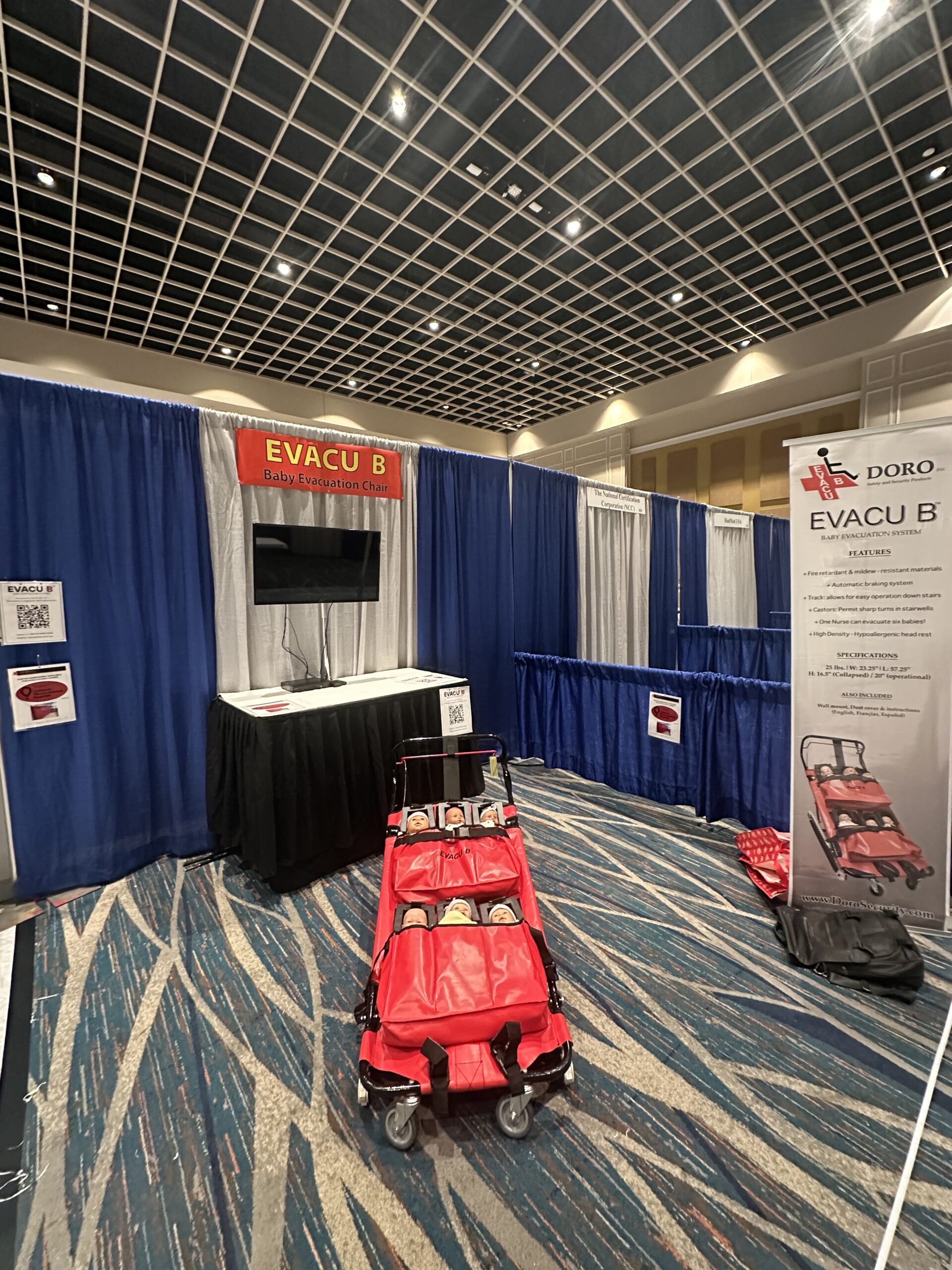
Staff immediately deployed three EvacuB evacuation sleds from designated storage areas. Each unit accommodated six infants, meaning three sleds provided capacity for all 12 NICU patients with room for equipment. The integrated oxygen cylinder cradles allowed staff to secure portable oxygen tanks directly to the sleds, maintaining respiratory support for oxygen-dependent infants throughout evacuation.
The automatic braking systems on the EvacuB sleds provided controlled stairwell descent without requiring staff to manually manage speed or worry about accelerating in downward stairwells. Single staff members operated each sled with six infants secured, demonstrating the equipment’s designed efficiency. This contrasted sharply with improvised carrying methods requiring multiple staff per infant.
Communication remained functional throughout this evacuation, as the fire didn’t compromise primary power or communication systems. Charge nurses coordinated with incident command, updated receiving areas about incoming patients, and maintained accountability for all infants throughout the process.
Outcomes and Lessons Reinforced
The fire was fully controlled within 45 minutes. All NICU infants returned to the unit after air quality testing confirmed safe conditions. No injuries occurred to patients or staff. Post-incident review identified the evacuation as a successful implementation of planned procedures.
Factors Contributing to Success:
- Purpose-built vertical evacuation equipment designed for the actual challenge (multi-story descent)
- Adequate equipment quantity for full patient census
- Regular training creating staff familiarity and confidence
- Clear role assignments preventing confusion
- Equipment features (automatic braking, integrated oxygen support) addressing known vertical evacuation challenges
Training Value Demonstrated:
Staff reported that quarterly drill practice with actual equipment made the real evacuation feel “just like a drill.” This psychological comfort helped staff maintain calm and focus on procedures rather than panicking about unfamiliar processes. The muscle memory from repeated practice showed in evacuation speed and coordination.
Equipment Investment Justified:
The facility’s post-incident review indicated that the evacuation equipment investment helped enable successful evacuation. Proper equipment and training can help facilities avoid potential complications during emergency evacuations.
What Made the Difference:
Comparing this evacuation to the Hurricane Sandy case reveals specific factors creating dramatically different experiences:
- Equipment designed for vertical evacuation vs. improvised carrying
- Regular practice with actual equipment vs. theoretical planning
- Maintained infrastructure (power, communications, lighting) vs. complete failure
- Contained emergency vs. catastrophic system collapse
- Appropriate equipment quantity available immediately vs. insufficient resources
This case study demonstrates that investment in proper equipment combined with regular training creates evacuation capability that functions effectively during actual emergencies—not just in theoretical planning documents.
Case Study 3: Tornado Warning Near-Miss and Shelter-in-Place Decision
Note: Facility details have been generalized to protect confidentiality.
A 2021 tornado warning affecting a rural hospital illustrates the decision-making challenges when evacuation may create greater risks than sheltering, and how tornado-specific planning differs from fire evacuation procedures.
The Weather Emergency
Tornado warnings issued at 4:35 PM gave staff approximately 12 minutes of advance warning before predicted tornado arrival. The hospital’s 8-bed Level II nursery housed six newborns at the time. The facility’s two-story structure made traditional vertical evacuation unnecessary, but the tornado threat created questions about whether moving infants presented greater risks than sheltering in place.
Hospital emergency planning identified an interior corridor with no windows as the designated tornado shelter area. This location provided more protection than patient rooms with exterior windows. However, reaching this shelter area required moving through approximately 150 feet of corridor from the nursery.
Staff faced real-time decisions:
- Do we shelter infants in the interior corridor despite losing access to most medical equipment?
- Or maintain care in the nursery with backup plans if windows fail?
- How do we transport six infants quickly with only two nurses immediately available?
The Response
The charge nurse decided on precautionary horizontal evacuation to the interior shelter corridor. Staff grabbed evacuation cribs, loaded infants quickly, and wheeled all six to the designated shelter area within 4 minutes. The flat terrain and relatively short distance made wheeled equipment ideal for this scenario.
While the sheltering lasted only 18 minutes before the warning lifted, the experience revealed several preparedness gaps:
- Medical equipment remained in the nursery, meaning staff had limited capacity to manage complications in shelter areas
- No portable lighting existed in the shelter corridor if power failed
- Communication in the interior corridor proved difficult
- Temperature control in the shelter area was poor, raising concerns about maintaining infant warmth during extended sheltering
The tornado ultimately missed the hospital. However, post-incident review recognized that proper tornado response requires planning beyond “get to an interior area.” Staff need equipment, supplies, and protocols for potentially extended stays in shelter locations while maintaining necessary care.
Lessons About Tornado-Specific Planning
Common themes observed from this experience include how tornado preparedness differs from fire evacuation:
Speed Requirements:
Tornadoes often provide less warning time than fires. The 12-minute advance warning this hospital received represents fortunate circumstances—many tornadoes touch down with far less warning. Tornado evacuation plans must focus on extremely rapid movement to shelter areas.
Shelter Location Considerations:
Unlike fire evacuations that move patients out of buildings, tornado sheltering moves patients to the safest areas within buildings. This requires different equipment (horizontal transport devices rather than stairwell-capable equipment) and different destination planning.
Extended Shelter Duration:
Fire evacuations typically end when buildings are cleared. Tornado sheltering may last hours as storms move through regions slowly. Plans must account for maintaining care in shelter locations rather than viewing sheltering as brief relocation.
Equipment in Shelter Areas:
Pre-positioning emergency equipment in designated shelter locations addresses the impossibility of relocating comprehensive medical equipment during rapid tornado response. Portable oxygen, basic monitoring equipment, emergency medications, and warming devices should be part of shelter area preparation.
Communication Challenges:
Interior corridors and basement shelter areas often lack good cell phone signals and communication systems. Alternative communication plans become crucial for maintaining contact with incident command and receiving updates about when sheltering can end.
What Hospitals in Tornado-Prone Regions Should Do:
- Designate specific tornado shelter locations with adequate space for all patients and necessary staff
- Pre-position essential equipment in shelter areas or maintain quick-access storage nearby
- Practice rapid horizontal evacuation using wheeled equipment designed for flat surfaces
- Develop protocols for maintaining care in shelter areas during extended stays
- Train staff on tornado-specific hazards and decision-making distinct from fire response
This case study demonstrates that “one size fits all” evacuation planning fails to address hazard-specific needs. Tornado preparedness requires planning approaches specifically designed for sudden-onset weather emergencies with potential for extended sheltering in confined interior spaces.
Case Study 4: Partial NICU Evacuation During Active Fire
Note: Facility details have been generalized to protect confidentiality.
A 2020 fire incident at a children’s hospital provides lessons about selective evacuation, when to move patients versus defend in place, and coordinating with fire department operations.
The Fire
A small fire ignited in a storage closet on a hospital floor housing a 20-bed NICU. Initial assessment suggested the fire remained contained with suppression systems activated. However, smoke began migrating through ventilation systems, affecting multiple areas including portions of the NICU.
Rather than complete evacuation, the facility implemented selective horizontal evacuation, moving only the eight infants in rooms experiencing smoke infiltration while leaving twelve infants in unaffected areas under close monitoring. This partial evacuation decision reflected real-time risk assessment balancing smoke exposure against the disruption and risks inherent in moving fragile patients.
Selective Evacuation Challenges
Selective evacuation created challenges distinct from complete evacuations. Staff needed to quickly assess which patients absolutely required movement versus who could safely remain. The eight infants selected for evacuation included those in rooms with visible smoke, infants on high-frequency ventilators that couldn’t be easily disconnected, and the most vulnerable patients who would fare worst if conditions deteriorated.
Equipment allocation became complex. With only partial evacuation needed, should staff deploy full evacuation equipment loads or use minimal resources assuming the evacuation would remain limited? The facility chose a middle approach—deployed one EvacuB sled (six-infant capacity) plus two evacuation cribs, providing capacity for the eight patients needing movement with backup if situations changed.
Coordination with firefighters added complexity. The fire department needed access to the fire area, requiring hospital staff to clear certain corridors. This created traffic conflicts between firefighters moving toward the fire with heavy equipment and hospital staff evacuating patients away from the fire. Communication between incident command and fire operations helped deconflict these movements but required active coordination.
Patient accountability proved challenging during partial evacuation. Maintaining clear records of which infants remained in the NICU versus which evacuated to receiving areas required deliberate tracking. One infant nearly got “lost” in the records when a nurse assumed the baby had evacuated when actually they remained in an unaffected NICU area.
Resolution and Lessons
Firefighters contained and extinguished the fire within 30 minutes. The eight evacuated infants returned to the NICU after air quality testing approximately two hours after evacuation. The selective evacuation approach proved appropriate for the limited fire scope.
Decision-Making Lessons:
- Selective evacuation requires clear criteria for who moves versus who stays
- Staff need training in risk assessment beyond “evacuate everyone always” protocols
- Accountability systems must track partial evacuations carefully
- Communication between hospital incident command and fire operations prevents dangerous conflicts
When Selective Evacuation Works:
- Contained fires affecting only portions of large departments
- Clear separation between affected and unaffected areas
- Adequate staff to simultaneously evacuate some patients while monitoring others
- Fire department confirms containment and limited spread risk
- Ability to quickly escalate to complete evacuation if conditions deteriorate
When Complete Evacuation Necessary:
- Rapidly spreading fires
- Smoke affecting all areas
- Fire department recommends complete evacuation
- Structural damage concerns
- Loss of critical building systems
This case reinforces that evacuation planning should include graduated responses, not just all-or-nothing protocols. Training staff in assessing situations and making selective evacuation decisions creates flexibility for responding appropriately to varying emergency scales.
Common Themes Across Case Studies
Examining multiple real-world evacuation cases reveals patterns commonly observed across different emergency types. These themes represent general observations that may not apply universally to all facilities.
Equipment Capabilities Matter
Documented cases where evacuations proceeded more smoothly often involved facilities that invested in purpose-built evacuation equipment designed for their specific building configuration and patient population. Facilities attempting evacuations with improvised solutions or equipment designed primarily for horizontal transport often encountered delays, safety concerns, and increased staff burden.
Automatic braking systems featured in modern evacuation sleds have demonstrated value in reported emergency implementations. Staff under stress, experiencing fatigue, and managing multiple patients simultaneously can benefit from equipment that reduces manual control requirements. Experience suggests that equipment requiring constant staff attention to prevent dangerous acceleration can create additional cognitive load during high-stress situations.
Training Frequency Affects Performance
Facilities conducting quarterly drills including actual equipment deployment often report better performance during real evacuations compared to those relying on annual paperwork reviews. Repeated practice with actual equipment can contribute to faster evacuation times, fewer procedural errors, and better staff confidence during actual emergencies.
Interestingly, the specific drill scenario matters less than the frequency of practice. Staff who regularly practice evacuating even with simplified scenarios still perform better than those who carefully plan complex scenarios but practice infrequently. Repetition builds competency more effectively than theoretical sophistication.
Communication Systems Need Redundancy
Nearly every evacuation case involves communication challenges. Building power loss affects phone systems. Stairwell acoustics prevent verbal communication between floors. High stress impairs clear thinking and speaking. Radio systems get overwhelmed when multiple departments simultaneously need communication.
Successful evacuations involve facilities that established redundant communication methods—dedicated evacuation radios separate from general use, runner systems for physical message carrying, visual signals for certain communications, and pre-established meeting points reducing the need for complex coordination messages during evacuations themselves.
Staffing Calculations Routinely Prove Optimistic
Planned evacuation staffing ratios consistently prove insufficient during actual emergencies. Factors rarely considered in planning create unexpected staff demands: some staff must manage the actual emergency (fight the fire, manage flooding), others provide patient care during evacuation, some handle communication and coordination, and certain situations require staff to remain with individual patients throughout evacuation.
Successful facilities plan for needing approximately 50-100% more staff than minimum calculations suggest. They establish mutual aid agreements with adjacent departments, train all staff (not just specialized pediatric nurses) in basic evacuation procedures, and maintain relationships with local emergency responders who can provide personnel if hospital staff alone proves insufficient.
Pre-Positioning Equipment Speeds Response
Facilities storing evacuation equipment in centralized locations distant from patient care areas experience delays retrieving and deploying equipment during actual emergencies. Those maintaining equipment immediately accessible to nursing units—in hallway alcoves, equipment rooms on the unit itself, or in clearly marked emergency equipment areas—deploy faster.
The tradeoff between centralized storage (requiring less equipment total) versus distributed storage (faster access, requires more equipment) consistently favors distributed storage in facilities that successfully evacuated quickly. The cost of additional equipment proves minimal compared to delays during actual emergencies.
Implementing Lessons Learned at Your Facility
Applying case study lessons to your specific facility requires systematic assessment and planning adaptation.
Equipment Assessment Process
Review your current evacuation equipment against real-world case study needs:
- Does your equipment accommodate your building configuration? (vertical vs horizontal)
- Have you calculated equipment quantity based on peak census plus backup capacity?
- Does equipment include features that proved valuable in actual evacuations? (automatic braking, integrated oxygen support, adequate capacity)
- Is equipment stored accessible to staff during emergencies?
Training Program Enhancement
Evaluate your training frequency and content against case study examples:
- Do you conduct quarterly physical drills with actual equipment?
- Do drills include realistic patient simulation rather than paperwork exercises?
- Have you practiced scenarios specific to your most likely emergencies?
- Does training include decision-making practice, not just following procedures?
Communication System Review
Assess communication redundancy:
- What happens to your communication systems when building power fails?
- Have you identified alternative communication methods for power-loss scenarios?
- Do stairwells have adequate lighting and communication capability?
- Have you practiced communications during actual drills to identify limitations?
Staffing Contingency Plans
Examine staffing assumptions:
- Does your plan account for staff managing the emergency itself?
- Have you established mutual aid agreements with other departments?
- Have you calculated staffing needs including 50-100% buffer for unexpected demands?
- Do you know how to rapidly request additional help during actual emergencies?
Infrastructure Protection
Consider infrastructure vulnerabilities revealed by case studies:
- Where are your backup generators located? (above flood plains)
- Are critical building systems protected from likely local hazards?
- Have you identified single points of failure in evacuation capability?
- What happens if your primary evacuation route becomes compromised?
Frequently Asked Questions
How often do hospitals actually evacuate their NICUs or nurseries?
Complete hospital evacuations remain rare—most hospitals never experience one. Partial evacuations of specific units occur more frequently, perhaps once every 5-10 years at a typical hospital. However, the consequences of being unprepared for that rare event prove catastrophic. The rarity of evacuations actually argues for more preparation since staff lack the real-world experience to guide them during actual emergencies.
Can we apply NICU evacuation lessons to maternity wards and pediatric units?
Many lessons apply across pediatric populations, though specific procedures adapt to patient differences. Equipment designed for infant transport works equally well for newborns in maternity wards. However, maternity evacuations must also address mothers—some of whom cannot ambulate after recent delivery. Pediatric unit evacuations involve different patient types (older children, some ambulatory) requiring different equipment mixes. The fundamental lessons about training frequency, communication redundancy, and equipment investment apply universally.
What if our facility cannot afford specialized evacuation equipment right now?
Even facilities with limited budgets can apply case study lessons. Maximize training frequency with whatever equipment you currently have—regular practice with basic equipment outperforms infrequent practice with ideal equipment. Develop mutual aid agreements with nearby facilities that might share resources during emergencies. Prioritize equipment acquisition starting with your most challenging scenarios (typically vertical evacuation). Many facilities phase equipment purchases over several years rather than trying to acquire everything at once.
Should we simulate disasters during our evacuation drills?
Limited disaster simulation improves decision-making practice—turning off certain lights to simulate power loss, restricting use of elevators, or adding unexpected complications. However, ensure simulation doesn’t compromise safety during the drill itself. Never create actual hazards to “make drills realistic.” Focus simulations on decision-making challenges and communication difficulties rather than creating physical dangers.
How do we know if our evacuation plan would actually work?
You never truly know until facing a real emergency. However, regular drills that feel increasingly confident, evacuation time improvements over successive practices, staff feedback indicating comfort with procedures, and external reviews by fire marshals or emergency management professionals provide reasonable confidence. Consider bringing in consultants who’ve managed actual hospital evacuations to review your plans and provide reality-based feedback.
What happens to evacuated patients after they leave the building?
Evacuation planning must extend beyond getting patients out. Where do they go? Most facilities identify receiving areas (other hospital buildings, nearby facilities with mutual aid agreements, emergency care spaces in parking areas). Plans include how patients receive ongoing care, how families find patients after evacuation, and when/how patients return after emergencies resolve. The NYU Langone case showed that getting patients out was only half the challenge—managing their care afterwards required extensive coordination.
Can regular hospital staff perform infant evacuations or do we need specialized personnel?
Regular staff with proper training can successfully evacuate infants. The NYU Langone case included non-pediatric staff contributing effectively to the physical transport. Equipment design affects this—systems requiring specialized skills need more training than intuitive equipment. Generally, focus training on regular staff rather than relying on specialized evacuation teams that might not be available during emergencies. Cross-training broadly creates more robust evacuation capability.
What role do hospital incident command systems play in evacuations?
Incident command coordinates overall response, makes evacuation decisions, manages communication with external agencies, and tracks resource allocation. Unit-level staff execute evacuations following procedures, but incident command provides strategic direction. Case studies show that clear lines between incident command (strategic) and unit operations (tactical) prevent confusion while ensuring appropriate coordination. Train both incident commanders and unit staff in their respective roles.
How do hospitals balance defend-in-place approaches with evacuation capability?
Modern hospital design uses defend-in-place as the primary strategy—fire-resistant construction, compartmentalization, and suppression systems allow patients to shelter safely rather than evacuate. However, multiple case studies prove that defend-in-place depends on infrastructure functioning. When backup generators fail, when fires exceed suppression capacity, or when structural damage compromises compartments, evacuation becomes necessary regardless of how challenging. Balanced planning maintains defend-in-place as primary strategy while ensuring evacuation capability when defense fails.
What metrics should we track from evacuation drills to measure improvement?
Key metrics include evacuation time from alarm to last patient evacuated, staff confidence ratings before and after drills, number and types of procedural deviations during drills, equipment deployment time, and safety incidents during drills. Track these metrics across multiple drills to identify trends. Improvement in evacuation time, increasing staff confidence, and decreasing procedural deviations indicate effective training programs.
Conclusion
Real-world hospital infant evacuation cases provide lessons that theoretical planning cannot match. The Hurricane Sandy NICU evacuation at NYU Langone revealed infrastructure vulnerabilities and equipment limitations that have influenced national preparedness standards. The Midwest hospital fire evacuation demonstrated how appropriate equipment and regular training creates confident, efficient emergency response. The Oklahoma tornado near-miss showed how different emergencies require specifically designed procedures rather than generic plans. The California selective evacuation illustrated decision-making complexities during contained emergencies.
Common themes emerge across all case studies. Equipment capabilities matter—purpose-built evacuation systems designed for specific challenges (particularly vertical evacuation) consistently perform better than improvised solutions. Training frequency directly affects performance, with regular physical drills creating muscle memory and confidence that paperwork exercises cannot replicate. Communication systems need redundancy because building infrastructure often fails during emergencies that trigger evacuations. Staffing calculations routinely prove optimistic, requiring facilities to plan for significantly more personnel than minimum calculations suggest.
Applying these lessons requires systematic facility assessment. Review evacuation equipment against real-world case study needs. Enhance training programs emphasizing frequency and physical practice over theoretical planning. Establish communication redundancy for scenarios when primary systems fail. Create staffing contingency plans acknowledging that actual emergencies consume more resources than predictions suggest.
The rarity of hospital evacuations creates training challenges—most staff will never experience a real evacuation during their careers. However, this rarity argues for more preparation, not less. Facilities facing actual emergencies without adequate preparation experience outcomes like the four-hour NYU Langone evacuation requiring human chains through dark stairwells. Facilities investing in equipment and training experience outcomes like the 27-minute Midwest evacuation where procedures “felt just like a drill.”
Your facility will likely never face a catastrophic evacuation. But the vulnerable patients depending on your care deserve the certainty that if that rare emergency occurs, your staff possess the equipment, training, and confidence to evacuate safely. Case studies from facilities that faced this reality prove that investment in preparation transforms potentially catastrophic scenarios into manageable challenges with successful outcomes.
About EvacuB
EvacuB manufactures infant evacuation equipment designed from real-world lessons learned during actual hospital evacuations. Our evacuation systems’ automatic braking and six-infant capacity directly address challenges identified in case studies like Hurricane Sandy where improvised methods required human chains and excessive staff resources.
Hospitals nationwide use EvacuB equipment to achieve evacuation times and staff efficiency proven in actual emergency deployments. The system’s design reflects input from facilities that experienced real evacuations, addressing practical challenges that emerge when theoretical planning meets reality.
Contact us to learn how EvacuB equipment applies real-world evacuation lessons to your facility’s emergency preparedness planning.