
Disclaimer: This article provides general educational information about hospital emergency evacuation equipment and is not professional medical, safety, or consulting advice. Healthcare facilities should consult qualified safety professionals, legal counsel, and regulatory authorities to ensure compliance with applicable standards. Regulatory requirements vary by jurisdiction and change over time—verify current requirements with relevant authorities.
Product performance, pricing, and specifications are subject to change. Information provided is current as of the publication date. Individual facility results vary based on building configuration, staff training, patient populations, and numerous other factors. Nothing in this article constitutes an endorsement of specific products or vendors. Healthcare facilities should evaluate equipment based on their specific needs and consult with qualified professionals.
Introduction
When a fire alarm sounds in your NICU at 2 AM with only four nurses on duty and 18 vulnerable infants depending on your staff, the evacuation equipment you’ve chosen becomes the difference between controlled evacuation and chaos. Hospitals across the United States face this reality: The Joint Commission requires demonstrated capacity for rapid patient evacuation, but the equipment market offers three distinctly different approaches—each with specific advantages, limitations, and use cases.
Infant evacuation equipment has evolved significantly from the days when nurses carried babies individually or used improvised solutions during emergencies. Today’s hospitals choose between evacuation vests that strap onto staff members, specialized evacuation cribs for wheeled transport, and evacuation sleds designed for horizontal and vertical movement. Understanding the fundamental differences between these systems helps safety directors, NICU managers, and procurement officers make informed decisions that balance regulatory compliance, staff capability, and patient safety.
This comprehensive comparison examines the three primary infant evacuation equipment categories based on real-world hospital implementations, regulatory requirements, and practical considerations for emergency situations. We’ll explore capacity limitations, stairwell capabilities, equipment costs, training requirements, and the specific scenarios where each system proves most effective.
Understanding Infant Evacuation Equipment Categories
Hospital infant evacuation equipment falls into three main categories, each engineered for different evacuation scenarios and facility configurations. Recognizing these fundamental distinctions helps facilities match equipment capabilities to their specific emergency preparedness needs.
Evacuation Vests and Aprons
Evacuation vests represent a wearable approach to infant transport. These fabric carriers feature multiple pockets or pouches that attach to a staff member’s torso, typically accommodating four to six infants depending on the design. The vest concept originated from disaster response scenarios where equipment availability was limited and improvisation necessary.
Modern evacuation vests incorporate flame-resistant materials meeting NFPA standards, secure infant compartments with individual support systems, and adjustable straps to fit various staff body types. Staff members don the vest, load infants into designated pockets, and evacuate while keeping hands relatively free for balance and door operation.
The vest category includes several design variations. Front-loading vests position infants against the wearer’s chest and abdomen. Back-loading designs place infants behind the carrier. Combination vests distribute weight between front and back positions. Each variation affects balance, visibility, and the evacuator’s ability to navigate obstacles.
Evacuation Cribs and Portable Isolettes
Evacuation cribs function as wheeled transport devices designed for horizontal movement through corridors. These specialized units resemble standard hospital cribs but incorporate features specific to emergency evacuation: secure infant restraints, lightweight construction for easy mobility, and sometimes collapsible designs for storage efficiency.
Portable isolettes represent a more sophisticated variation within this category. These enclosed units maintain some level of environmental control during transport, making them suitable for infants requiring strict temperature or atmospheric management. However, their enclosed design and weight create limitations for certain evacuation scenarios.
The wheeled category excels in facilities with single-story construction or when elevators remain operational. Modern designs incorporate oxygen cylinder holders, equipment storage compartments, and push handles positioned for ergonomic operation. Most evacuation cribs accommodate one to two infants, though larger models exist for specific applications.
Evacuation Sleds and Horizontal Transport Systems
Evacuation sleds take a different approach, combining aspects of both previous categories while adding capabilities neither can match. These devices feature a rigid base supporting multiple infant positions, designed for both horizontal floor movement and controlled stairwell descent.
Sled systems incorporate several engineering features addressing the specific challenges of multi-story hospital evacuations. Automatic braking systems engage during downward stairwell movement, preventing dangerous acceleration. Low-profile designs fit through standard doorways and narrow passages. Integrated equipment cradles secure oxygen cylinders, monitors, and other necessary medical devices during transport.
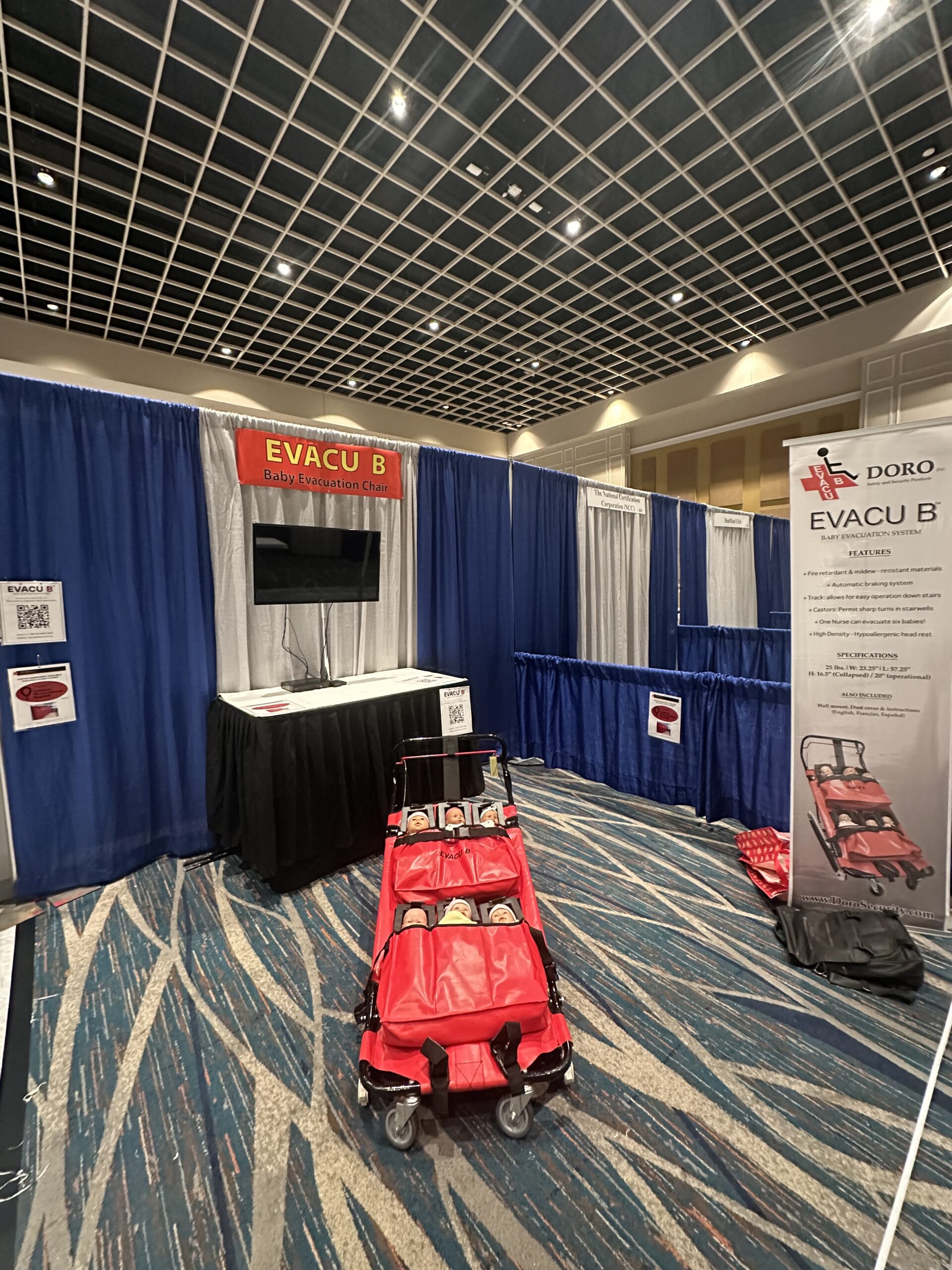
The EvacuB evacuation sled exemplifies this category’s capabilities. With six-infant capacity and automatic braking for controlled stair descent, the system addresses multiple evacuation challenges simultaneously. Staff can transport six infants with a single operator, reducing personnel requirements while maintaining safety through engineered control systems.
Capacity Analysis: Patients Per Evacuation Unit
Evacuation capacity directly impacts staffing requirements and evacuation speed—two critical factors when moving vulnerable patients during emergencies. Understanding the practical capacity of each equipment type reveals significant operational differences.
Vest System Capacity
Manufacturer specifications typically rate evacuation vests at four to six infant capacity. However, real-world capacity depends on several factors. Infant weight affects how many the vest wearer can safely carry while maintaining balance and mobility. Staff member size and physical capability influences practical capacity. Infant medical equipment needs may reduce the number of infants one vest can accommodate.
Field testing at various hospitals reveals that practical vest capacity often runs lower than manufacturer ratings. A vest rated for six infants may realistically accommodate four or five when factoring in infant weights ranging from five to eight pounds, the physical demands of stairwell navigation, and the need for staff to maintain situational awareness during evacuation.
For a 24-bed NICU using evacuation vests, achieving full evacuation requires approximately four to six equipped staff members, assuming each carries four infants. During off-shift hours when staffing typically drops to four or five nurses total, this creates a significant challenge. Not all nurses may possess the physical capability to safely wear and evacuate with loaded vests, further complicating capacity calculations.
Crib and Isolette Capacity
Evacuation cribs typically accommodate one infant, though some larger models handle two. This one-to-one or one-to-two ratio means a 24-bed NICU requires 12 to 24 evacuation cribs for complete capacity.
The equipment-to-patient ratio creates storage challenges. Where does a facility store 12 to 24 evacuation cribs while keeping them accessible for immediate deployment? Many hospitals address this by maintaining a partial inventory of evacuation cribs and supplementing with standard cribs during actual emergencies. This approach works if time permits equipment retrieval but proves problematic during rapid-onset emergencies.
Portable isolettes face even more severe capacity limitations. Their enclosed design and life support integration typically restrict capacity to one infant. A NICU requiring isolette-level care during evacuation faces a nearly one-to-one equipment-to-patient ratio, creating substantial logistical challenges.
Sled System Capacity
Modern evacuation sleds address capacity limitations through engineered multi-patient designs. The EvacuB system’s six-infant capacity means a 24-bed NICU requires only four units for complete evacuation capability. This 6:1 ratio dramatically reduces both equipment needs and staffing requirements.
Six-infant capacity creates operational advantages beyond pure numbers. Storage requirements drop to one-sixth those of single-patient systems. Staff training focuses on fewer pieces of equipment. Quality control and maintenance become more manageable with a smaller equipment inventory. Equipment acquisition costs decline when purchasing four units instead of 24.
The capacity advantage becomes most apparent during off-hours evacuation scenarios. With four EvacuB units and four staff members, a facility can evacuate 24 infants in a single trip. The same scenario using single-infant cribs would require multiple trips or significantly more personnel.
Stairwell Capability and Vertical Evacuation
Multi-story hospitals face unique evacuation challenges. Elevators become unavailable during fire emergencies. Power failures disable automatic systems. Structural damage may compromise certain exit routes. These scenarios force vertical evacuation using stairwells—where equipment capability differences become critically apparent.
Vest Performance in Stairwells
Evacuation vests allow staff to navigate stairwells hands-free, a significant advantage over equipment requiring pushing or pulling. However, several factors complicate vest-based stairwell evacuation.
Weight distribution affects balance during descent. Four to six infants, even small ones, create 20 to 40 pounds of load on the vest wearer’s torso. This forward-shifted weight changes the carrier’s center of gravity, increasing fall risk on stairs. Staff members descending stairs while carrying this load report increased fatigue, balance challenges, and anxiety about maintaining control.
Visibility poses another concern. Infants positioned in front-loading vests obstruct the wearer’s view of stairs and foot placement. This limited visibility increases fall risk, particularly during rapid evacuation when staff cannot take time for careful foot placement. Back-loading vests improve visibility but create other challenges with balance and awareness of infant status during descent.
Physical capability variations among staff members create planning challenges. Not all nurses possess the strength, balance, and endurance to safely descend multiple flights of stairs while wearing loaded evacuation vests. This variability means facilities cannot assume all staff can serve as evacuators during vertical evacuation scenarios.
Crib and Isolette Performance in Stairwells
Wheeled evacuation equipment faces severe limitations in stairwells. Standard evacuation cribs cannot descend stairs safely. Their wheeled design excels on horizontal surfaces but becomes a liability on stairs.
Some hospitals maintain evacuation cribs for horizontal movement to stairwells, then transfer infants to other carrying methods for the actual stairwell descent. This approach adds steps, requires additional equipment, and slows overall evacuation. In time-critical emergencies, every additional step introduces delay and potential complications.
Portable isolettes face even greater stairwell challenges. Their weight—often 40 to 60 pounds empty—makes carrying difficult. Add an infant and necessary equipment, and single-person transport becomes nearly impossible. Most isolette evacuation protocols require two staff members per unit for stairwell navigation, doubling personnel requirements.
The equipment transfer approach creates another problem: isolette-dependent infants may lose environmental control during transfer to carrying methods. For infants requiring strict temperature or atmospheric management, even brief exposure to uncontrolled conditions during transfer poses risks.
Sled Performance in Stairwells
Evacuation sleds designed for vertical movement address stairwell challenges through engineered solutions. The EvacuB system incorporates automatic braking that engages during downward stairwell movement, providing controlled descent without requiring staff to manually brake or control speed.
This automatic braking proves particularly valuable during emergency evacuations when stress, fatigue, and urgency can affect staff performance. The system’s mechanical braking removes human control requirements, allowing staff to focus on patient monitoring and safe navigation rather than constant speed control.
Low-profile sled designs navigate standard stairwell widths. The EvacuB unit’s dimensions accommodate typical 42- to 48-inch stairwell widths found in most hospitals, fitting through standard doorways and making turns at stairwell landings. This dimensional compatibility means staff don’t encounter stuck equipment mid-descent—a critical consideration during time-pressured evacuations.
The sled’s horizontal orientation during transport maintains infant positioning and equipment stability. Oxygen cylinders secured in integrated cradles remain accessible throughout descent. Monitors and other equipment stay in position. This stability contrasts with vest systems where infant positioning may shift during movement and equipment accessibility becomes challenging.
Training Requirements and Learning Curve
Equipment effectiveness depends heavily on staff competency. Training requirements vary significantly across equipment categories, affecting both initial implementation timelines and ongoing competency maintenance.
Vest Training Complexity
Evacuation vest training encompasses several components. Staff must learn proper vest fitting and adjustment for their body type. They practice infant loading sequences—which pocket to fill first, how to distribute weight, and how to secure infants while managing multiple patients simultaneously.
Physical training proves critical for vest systems. Staff need conditioning for carrying 20 to 40 pounds of load while maintaining mobility and balance. This physical component means some staff members may never achieve competency regardless of training time invested—a reality hospitals must acknowledge when planning evacuation capacity.
Stairwell descent training with loaded vests requires careful supervision and multiple practice iterations. Staff must develop confidence navigating stairs while managing shifted center of gravity and limited visibility. Many facilities report that achieving comfortable competency with vest-based stairwell descent requires five to seven practice sessions per staff member.
Ongoing competency maintenance presents challenges. Staff turnover requires frequent onboarding training. Annual or quarterly drills must include vest-specific practice to maintain skills. The physical demands mean staff conditioning requirements continue between drills to maintain evacuation capability.
Crib and Isolette Training
Evacuation crib training proves relatively straightforward for horizontal movement. Most nurses already possess the skills for wheeling hospital equipment through corridors. Training focuses on infant securing techniques, equipment deployment procedures, and coordination during multi-unit evacuations.
However, stairwell training for crib systems becomes complicated by the transfer requirements. Staff must learn when to transfer infants from cribs to carrying methods, how to perform transfers under stress, and how to coordinate multiple staff members during the transfer and subsequent carry phases.
Isolette training adds complexity through equipment-specific procedures. Staff learn isolette operation, how to maintain environmental controls during evacuation, transfer techniques for equipment-dependent infants, and emergency protocols when equipment malfunction occurs during evacuation.
The multiple-step process required for crib or isolette-based vertical evacuation means staff must practice complete sequences repeatedly to achieve competency. Simply knowing each step doesn’t ensure smooth execution during high-stress emergencies.
Sled Training Efficiency
Evacuation sled training benefits from the equipment’s intuitive operation. The EvacuB system’s design allows most staff to achieve basic competency within a single training session. This accelerated learning curve reflects several design factors.
The automatic braking system removes manual control requirements during stairwell descent. Staff don’t need to learn specialized braking techniques or develop the physical strength to control descent manually. The system’s mechanical braking ensures consistent, safe descent regardless of staff experience level.
Infant loading follows logical sequences. Six clearly marked positions indicate where to place each infant. Equipment cradles show where to secure oxygen cylinders and other devices. The intuitive design reduces the cognitive load during already stressful evacuation situations.
Single-person operation means training focuses on individual competency rather than coordinated team procedures. While team coordination skills remain valuable, the fundamental equipment operation doesn’t require synchronized multi-person actions. This independence simplifies training logistics and reduces the staff-matching requirements that complicate team-based procedures.
Annual drill refreshers maintain competency more efficiently with sled systems. Staff who haven’t practiced in months can typically demonstrate safe operation after brief reorientation. The equipment’s design features—automatic braking, clear infant positions, integrated equipment storage—serve as operational reminders, reducing the knowledge degradation that occurs between practice sessions.
Safety Features and Risk Mitigation
Safety features engineered into evacuation equipment directly affect patient and staff protection during emergencies. Understanding built-in safety mechanisms helps facilities evaluate equipment beyond basic capacity specifications.
Vest Safety Considerations
Evacuation vests incorporate several safety features. Flame-resistant fabrics meeting NFPA 701 standards protect against heat and flame exposure during fire-related evacuations. Individual infant pockets with securing systems prevent patients from shifting or falling during movement. Adjustable staff harnesses distribute weight to reduce fatigue-related risks.
However, vests create inherent safety challenges that design features cannot fully eliminate. The wearer’s stability directly affects patient safety—if the staff member falls, all carried infants face injury risk. This single-point-of-failure characteristic means vest systems require careful staff selection and physical capability assessment.
Infant accessibility during evacuation presents another safety consideration. Once loaded in vest pockets, infants become difficult to reach for assessment or intervention. A nurse wearing a loaded vest cannot easily check on infants positioned behind them or make rapid equipment adjustments without first removing infants or the entire vest.
The physical demands create fatigue-related safety risks. Staff carrying loaded vests for extended periods—whether during actual evacuations or during delayed mustering after exiting the building—experience progressive fatigue that affects balance, judgment, and decision-making capability.
Crib and Isolette Safety Features
Evacuation cribs and isolettes provide several safety advantages. Individual patient containment means one equipment failure doesn’t affect multiple patients. Wheeled operation reduces physical strain on staff, decreasing fatigue-related errors. The larger equipment footprint accommodates better infant securing systems than compact vest pockets.
Isolettes offer specific safety benefits for equipment-dependent infants. Environmental control maintenance during initial evacuation stages protects vulnerable patients. Equipment integration capabilities support continuous monitoring and oxygen delivery. The enclosed design provides some physical protection during movement through potentially hazardous areas.
Safety limitations emerge during stairwell evacuation. Transfer procedures introduce handling risks at precisely the moment when speed and stress are highest. The need for multiple staff members per isolette means a shortage of personnel anywhere in the evacuation chain creates bottlenecks that delay everyone.
Equipment tipping poses a risk during wheeled operation. Uneven surfaces, door thresholds, and rapid directional changes can cause crib or isolette tipping, potentially injuring the infant and blocking evacuation routes. While modern designs incorporate wider bases for improved stability, the wheeled nature creates this inherent instability risk.
Sled Safety Engineering
Evacuation sleds incorporate multiple engineered safety features. The EvacuB system’s automatic braking represents a fundamental safety advancement—removing human control requirements during stairwell descent eliminates a major failure point. Staff cannot “miss” a braking action or apply insufficient force when the system operates mechanically.
Low center of gravity design reduces tipping risk. Unlike tall wheeled equipment, sleds maintain stability even during rapid directional changes or when navigating uneven surfaces. This stability proves particularly valuable when moving through debris-affected areas during disaster-related evacuations.
Integrated equipment securing prevents dangerous shifting during movement. Oxygen cylinders locked in dedicated cradles cannot become projectiles during rapid descent. Equipment remains accessible throughout evacuation, allowing staff to monitor and adjust as needed without stopping or removing patients from the evacuation device.
The horizontal patient positioning maintains infants in physiologically neutral positions. Contrast this with vest systems where infant positioning varies based on pocket design and body position, or vertical holding during crib-to-carry transfers. The sled’s flat surface supports proper infant positioning throughout the evacuation sequence.
Six-infant capacity creates redundancy advantages. If one staff member becomes incapacitated, another can take over sled operation with all six infants remaining together and secured. This contrasts with vest systems where incapacitated staff require complex load transfers to other personnel.
Equipment Costs and Budget Considerations
Financial factors influence equipment selection significantly. Understanding total cost of ownership—acquisition costs plus ongoing expenses—provides realistic budget planning information.
Vest System Costs
Evacuation vests generally represent the lowest initial acquisition cost among infant evacuation equipment categories. This lower upfront cost makes vests attractive for facilities facing tight budget constraints. However, total cost of ownership includes factors beyond initial purchase. Vest systems require larger trained staff pools since not all personnel can safely operate loaded vests. This training cost multiplier affects the true system cost.
For current pricing information, contact equipment vendors directly.
Annual replacement costs affect long-term budgeting. Fabric-based equipment experiences wear from repeated use, laundering, and exposure to cleaning agents. Many facilities report vest useful life around three to five years, meaning regular replacement cycles. Storage and organization systems for maintaining multiple vests add modest but recurring costs.
The physical capability requirements mean facilities may need to adjust staffing ratios or hire additional personnel specifically capable of vest evacuation duties. While not strictly an “equipment cost,” this staffing impact affects total system expense.
Crib and Isolette Costs
Evacuation cribs cost significantly more than vests. Specialized evacuation cribs with enhanced features carry premium pricing. A 24-bed NICU requiring 12 to 24 evacuation cribs faces substantial acquisition costs depending on quantity and sophistication.
This considerable upfront investment explains why many facilities maintain only partial crib inventories, planning to supplement with standard cribs during actual emergencies. However, this compromise strategy assumes time for equipment gathering—potentially dangerous during rapid-onset emergencies.
Portable isolettes represent the highest cost category. These specialized units require significant equipment investments, even for facilities requiring isolette-level evacuation capability for only a subset of patients.
For current pricing information, contact equipment vendors directly.
Storage infrastructure adds to crib and isolette costs. Facilities need designated storage areas for multiple large pieces of equipment while maintaining accessibility for emergency deployment. Some hospitals invest in specialized storage systems that mount cribs on walls or in overhead racks, adding thousands to total system cost.
Maintenance costs for wheeled equipment include regular inspection of casters, wheels, brakes, and rolling mechanisms. Isolettes require additional maintenance for environmental control systems, battery backup components, and specialized medical equipment integration features.
Sled System Costs
Evacuation sleds fall into the mid-to-upper cost range. The EvacuB system’s pricing reflects its higher capacity and specialized engineering features.
When evaluating per-patient-position costs, sled systems often compare favorably to multiple single-patient cribs. The equipment quantity needed (4 sleds vs. 12-24 cribs for a 24-bed NICU) affects total system acquisition costs.
For current pricing information, contact equipment vendors directly.
The sled system’s durability affects long-term costs. Rigid construction with mechanical components typically outlasts fabric-based systems by significant margins. Many facilities report sled equipment lifespans exceeding 10 years with proper maintenance. This extended useful life reduces annualized equipment costs substantially.
Lower training costs contribute to total cost of ownership advantages. The shorter learning curve means less staff time devoted to initial training. More efficient competency maintenance means less drill time. The single-person operation reduces the staff coordination training that team-based systems require.
Storage costs for four sled units compare favorably against storing 12 to 24 cribs. The reduced equipment volume creates flexibility in storage location and accessibility optimization.
Regulatory Compliance and Standards
Equipment selection must address regulatory requirements from The Joint Commission, state health departments, fire marshals, and other authorities. Understanding how each equipment category addresses compliance needs prevents post-purchase complications.
Joint Commission Requirements
The Joint Commission doesn’t mandate specific evacuation equipment types. Instead, standards require hospitals to demonstrate capability for rapid, safe patient evacuation. This performance-based approach means facilities can meet requirements with various equipment configurations.
However, equipment capabilities directly affect a facility’s ability to demonstrate compliance during surveys and drills. Surveyors assess whether evacuation procedures could actually achieve timely egress based on available staffing and equipment. A facility with insufficient evacuation capacity for its patient census may receive compliance findings even if equipment technically meets safety standards.
Standard EC.02.06.01 requires healthcare occupancies to maintain capability for horizontal and vertical evacuation. This explicitly includes stairwell egress capability. Equipment limited to horizontal evacuation only—such as standard wheeled cribs—may not fully address this standard’s requirements without supplementary capabilities for vertical movement.
Fire drill requirements under standard EC.02.03.05 include actual patient movement during at least one drill annually. Equipment that proves impractical during training drills raises questions about real-world efficacy. Surveyors note when staff struggle with equipment operation, when multiple drill attempts fail to achieve timely evacuation, or when physical capability limitations prevent staff participation.
NFPA Standards Relevance
NFPA 101 Life Safety Code establishes construction and equipment standards affecting hospital design and operation. While NFPA 101 doesn’t prescribe specific infant evacuation equipment, it establishes fire-resistance requirements for materials and emergency lighting provisions that affect equipment design.
Evacuation equipment fabric components must meet NFPA 701 flame resistance standards. Both vest and fabric-based sled components fall under these requirements. Equipment manufacturers should provide test documentation demonstrating NFPA 701 compliance.
NFPA 99 Health Care Facilities Code addresses broader safety systems. While this standard primarily concerns building systems rather than evacuation equipment, it establishes the regulatory framework under which health care emergency planning occurs.
State and Local Variations
State health departments often establish additional requirements beyond federal standards. Some states mandate specific evacuation equipment quantities based on licensed bed capacity. Others require particular equipment features or capabilities. Facilities should verify state-specific requirements before major equipment purchases.
Fire marshal requirements vary by jurisdiction. Some authorities having jurisdiction require demonstrations of vertical evacuation capability during pre-occupancy inspections. Others mandate regular evacuation drills including actual patient movement. Equipment capabilities must match these local requirements.
Equipment Certifications and Testing
Beyond regulatory compliance, equipment certifications provide quality assurance. ASTM International publishes standards for medical equipment including patient transport devices. While ASTM standards aren’t always regulatory requirements, they represent industry consensus on safety and performance baselines.
Equipment manufacturers should provide testing documentation. This includes materials testing (flame resistance, structural integrity), performance testing (weight capacity, braking system function), and safety testing (patient security, equipment stability). Facilities purchasing evacuation equipment should request and review this documentation.
Third-party testing provides additional confidence. Independent testing organizations verify manufacturer claims and ensure equipment performs as specified. UL (Underwriters Laboratories) and similar organizations conduct testing that supports regulatory compliance demonstrations.
Real-World Implementation Examples
Understanding how hospitals actually implement different equipment types provides practical insights beyond specification sheets and marketing materials.
Large Urban Hospital: Mixed Equipment Approach
A 350-bed urban teaching hospital with Level III NICU implemented a mixed equipment strategy. They maintain EvacuB sleds for their three-story main hospital building where vertical evacuation capability proved essential. These four units provide capacity for the 24-bed NICU on the third floor.
The same facility uses evacuation vests in their single-story outpatient maternal services building. With no vertical evacuation requirements and shorter evacuation distances, vests provide sufficient capability while minimizing equipment costs for this lower-acuity area.
This mixed approach reflects thoughtful matching of equipment capabilities to specific building and patient population characteristics. The facility reports high drill success rates and staff confidence with the situation-specific equipment.
Community Hospital: Vest-Based System
A 120-bed community hospital with 12-bed Level II NICU selected evacuation vests as their primary system. Their two-story building includes a stairwell with particularly wide dimensions (60 inches) and handrails on both sides, providing staff with enhanced support during descent.
The facility emphasizes physical fitness standards in their nursing staff recruiting and implements quarterly strength and conditioning sessions focused on evacuation capability. This proactive fitness approach addresses the physical demands vest systems create.
Staff report that the vest system works well for their moderate patient volumes and staffing levels. However, the facility plans to add evacuation sleds if they expand NICU capacity or add floors to their building.
Regional Medical Center: Sled-Focused Strategy
A 280-bed regional medical center with Level III NICU serving a multi-county area selected EvacuB sleds as their primary evacuation equipment. Their five-story hospital tower creates significant vertical evacuation challenges that influenced equipment selection.
The facility maintains six EvacuB units for their 30-bed NICU, providing capacity for all patients plus backup units. They supplement with two evacuation cribs for horizontal transport of infants being admitted or discharged during emergencies.
Staff at this facility reported evacuation times that were significantly faster than their previous crib-based system in drill scenarios. Staff report higher confidence levels and less fatigue after evacuation drills. The facility’s most recent Joint Commission survey noted their evacuation capability demonstration.
Specialized Children’s Hospital: Comprehensive Approach
A 200-bed pediatric specialty hospital maintains multiple equipment types for different scenarios. Their NICU uses EvacuB sleds for complete evacuation capability. They keep evacuation vests available for selective evacuations involving only a few patients. They maintain evacuation cribs for horizontal transport within single-floor evacuations.
This comprehensive approach costs more upfront but provides flexibility for various scenarios. During a recent tornado warning that required moving patients to interior corridors but not exiting the building, they used wheeled cribs for rapid horizontal repositioning. During annual vertical evacuation drills, they rely on sleds for their superior stairwell performance.
Selecting the Right System for Your Facility
Equipment selection should reflect your facility’s specific characteristics, patient population, physical plant, and operational constraints. A systematic evaluation process addresses all relevant factors.
Facility Assessment Factors
Building configuration fundamentally affects equipment suitability. Single-story facilities eliminate vertical evacuation requirements, making wheeled equipment viable. Multi-story buildings require careful evaluation of stairwell dimensions, configurations, and accessibility before selecting equipment primarily designed for horizontal movement.
Patient census influences equipment quantity needs. A 12-bed NICU requires less equipment than a 40-bed unit. Calculate equipment needs based on peak census rather than average census—emergencies don’t wait for low-census periods.
Staffing patterns affect equipment selection. Facilities with generous nursing ratios and large staff pools during all shifts have more flexibility in equipment choice. Facilities operating with minimal staff during off-hours need equipment that maximizes each person’s evacuation capacity.
Storage availability matters. Where will equipment live when not in use? How quickly can staff access it during emergencies? Facilities with limited storage may favor compact equipment or systems requiring fewer units.
Budget constraints create real limits. While we should select equipment based on safety and effectiveness first, the reality is that financial factors influence decisions. Understanding total cost of ownership—not just acquisition cost—helps facilities make informed budget-based decisions.
Operational Considerations
Staff physical capability varies among facilities. Organizations with predominantly younger, physically fit staff may successfully implement vest systems that wouldn’t work elsewhere. Facilities with diverse staff populations spanning wide age ranges and physical capabilities may need equipment with less demanding physical requirements.
Training capacity affects implementation timelines. Facilities with robust training programs, dedicated nurse educators, and time for comprehensive competency development can successfully implement any equipment type. Organizations with limited training resources should favor equipment with shorter learning curves.
Drill frequency influences competency maintenance. Facilities conducting quarterly drills maintain staff competency more effectively than those drilling annually. Equipment requiring frequent practice to maintain skills may challenge facilities with limited drill schedules.
Patient acuity levels affect equipment needs. Level IV NICUs caring for extremely premature infants with extensive equipment dependencies face different challenges than Level II nurseries caring for feeders and growers. Higher acuity patients may require more sophisticated equipment capabilities.
Comparison Decision Matrix
When evaluating equipment options, consider these key factors:
Capacity Requirements:
- How many infants need evacuation capability?
- What staffing levels are available during minimum-staff periods?
- Can your facility evacuate all patients simultaneously if needed?
Vertical Evacuation Needs:
- Does your facility include multiple stories?
- Are stairwells the only vertical egress option?
- What are stairwell dimensions and configurations?
Staff Capabilities:
- What physical capability range exists in your nursing staff?
- Can all staff safely operate all equipment types?
- How does turnover affect training requirements?
Budget Allocation:
- What funding exists for initial equipment purchase?
- Are ongoing replacement costs budgeted?
- Does training time cost affect the decision?
Regulatory Environment:
- What does your state require specifically?
- What has your fire marshal indicated during inspections?
- What did Joint Commission surveyors note during recent visits?
Equipment Comparison Summary Table
Note: Facility-specific needs vary. Consult safety professionals for recommendations specific to your situation. Individual results vary based on facility characteristics, staff training, and specific scenarios.
| Feature | Evacuation Vests | Evacuation Cribs | Evacuation Sleds (EvacuB) |
|---|---|---|---|
| Infant Capacity | 4-6 infants | 1-2 infants | 6 infants |
| Units for 24-bed NICU | 4-6 vests | 12-24 cribs | 4 sleds |
| Relative Cost | Lowest | High | Mid-to-Upper |
| Equipment Quantity (24 beds) | 4-6 vests | 12-24 cribs | 4 sleds |
| Stairwell Capable | Yes (limited) | No (transfer required) | Yes (automatic braking) |
| Staff Required | 1 per vest | 1-2 per crib | 1 per sled |
| Physical Demands | High | Low-Moderate | Moderate |
| Training Complexity | High | Moderate | Low-Moderate |
| Learning Curve | 5-7 sessions | 2-3 sessions | 1-2 sessions |
| Hands-Free Operation | Yes | No | Mostly yes |
| Oxygen Support | Limited | Possible | Integrated cradle |
| Equipment Lifespan | 3-5 years | 7-10 years | 10+ years |
| Storage Space | Minimal | Significant | Moderate |
| Often Suited For | Single-story, fit staff | Horizontal evacuation | Multi-story, all staff |
Frequently Asked Questions
How many pieces of evacuation equipment does our NICU need?
Equipment quantity depends on your licensed bed capacity and peak census levels. Calculate based on equipment capacity—a 24-bed NICU using six-infant capacity sleds needs four units minimum. Add 10-15% backup capacity for equipment maintenance and simultaneous-use scenarios. Facilities should maintain enough equipment to evacuate all patients without relying on multiple trips, as return entry may become impossible during actual emergencies.
Can our staff really evacuate six infants at once safely?
Yes, with properly designed equipment. The EvacuB sled’s automatic braking removes manual control requirements during stairwell descent, addressing the primary safety concern with high-capacity systems. The horizontal patient positioning and integrated equipment cradles maintain infant security throughout evacuation. Staff training focuses on confident operation rather than strength or intensive physical capability. Hundreds of hospitals successfully implement six-infant capacity systems after completing appropriate training programs.
What if we have a mix of ambulatory patients and equipment-dependent infants?
Most facilities handle mixed-acuity populations by prioritizing evacuation equipment for the highest-need patients. Equipment-dependent infants requiring oxygen or monitoring equipment benefit from evacuation systems with integrated equipment support. More stable infants may evacuate using simpler methods. During planning, identify which patients absolutely require specialized equipment versus those who could evacuate with basic carrying methods if necessary. Size your specialized equipment inventory accordingly.
How do evacuation vests work during real emergencies when staff are already fatigued?
This represents a legitimate concern with vest systems. The physical demands multiply under emergency stress when staff may have already worked a full shift and dealt with emergency preparations before evacuation even begins. Some facilities address this by maintaining vest systems but limiting their use to physically capable staff members who specifically train for evacuation duties. Others implement hybrid approaches where vests supplement higher-capacity equipment rather than serving as the primary system.
Will insurance premiums decrease if we invest in better evacuation equipment?
Some insurers offer premium reductions for facilities demonstrating superior emergency preparedness. However, premium impacts vary widely by insurer, location, and facility characteristics. When evaluating equipment investments, focus primarily on regulatory compliance and patient safety. Any insurance benefits should be considered bonus factors rather than decision drivers. Contact your insurance carrier to discuss whether documented evacuation capability improvements would affect premiums at your facility.
What happens to our evacuation equipment between emergencies?
Proper storage and maintenance extends equipment lifespan significantly. Store equipment in climate-controlled areas protected from UV light, moisture, and temperature extremes. Conduct quarterly inspections checking all securing systems, checking for material degradation, testing braking systems, and verifying that all components remain present and functional. Schedule annual professional maintenance for mechanical components. Maintain equipment cleaning logs and document all inspections as part of your Joint Commission survey preparation.
Can we use the same equipment for both fire drills and natural disaster evacuations?
Yes, and this represents a key advantage of comprehensive evacuation equipment. Fire scenarios, natural disasters, utility failures, and other emergencies all potentially require patient evacuation. Equipment designed for the most challenging scenario (typically vertical evacuation during fires) handles other situations effectively. The EvacuB system’s “all-hazard” capabilities address fire, tornado, flood, earthquake, and other scenarios requiring rapid egress from the building or relocation to protected areas within the facility.
How long does staff training take before we can safely use evacuation equipment?
Training timelines vary by equipment complexity. Evacuation sleds typically require one to two training sessions for basic competency, with quarterly drills maintaining skills. Evacuation vests need five to seven training sessions due to physical conditioning requirements and the coordination needed for loaded vest operation. Evacuation cribs fall in the middle, requiring two to three training sessions for competency. All equipment types benefit from regular practice—quarterly drills help maintain competency and identify staff members needing additional training.
What if we’re a single-story facility—do we still need this level of equipment?
Single-story facilities still benefit from purpose-built evacuation equipment, though vertical capability becomes less critical. Focus equipment selection on capacity and horizontal movement efficiency. Even without stairwells, high-capacity equipment like evacuation sleds reduces personnel requirements and speeds evacuation. The EvacuB system’s six-infant capacity allows four staff members to evacuate 24 infants simultaneously, creating significantly faster egress than one-infant cribs requiring 24 trips or 24 staff members.
How do we demonstrate ROI on evacuation equipment to hospital administration?
Build your business case around multiple factors. Regulatory compliance value includes avoiding Joint Commission findings, passing fire marshal inspections, and meeting state licensing requirements. Risk mitigation value encompasses liability reduction, insurance considerations, and reputation protection. Operational efficiency shows reduced staffing requirements during evacuations and faster drill completion times. Staff confidence reflects improved morale when nurses feel prepared for emergencies. Document these factors with specific numbers: “Current system requires 12 staff for evacuation vs. proposed system requiring 4 staff” creates compelling financial arguments.
Conclusion
Infant evacuation equipment selection represents a critical decision affecting patient safety, regulatory compliance, and operational efficiency during potentially life-threatening emergencies. The three primary equipment categories—vests, cribs, and sleds—each offer specific advantages for particular facility configurations and operational contexts.
Evacuation vests provide the lowest acquisition cost and work well in single-story facilities with physically capable staff. Their lightweight design and wearable format allow rapid deployment but create physical demands that limit universal staff capability. Stairwell use remains possible but challenging due to balance and visibility concerns.
Evacuation cribs excel at horizontal transport and individual patient containment but struggle with vertical evacuation requirements. Their wheeled design suits single-story configurations or scenarios where elevators remain operational. The one-to-two infant capacity creates higher equipment inventory needs and storage challenges.
Evacuation sleds like the EvacuB system combine high patient capacity with vertical evacuation capability through engineered automatic braking systems. The six-infant capacity reduces both equipment needs and staffing requirements significantly. Intuitive operation creates shorter training timelines and better competency retention. The higher per-unit cost delivers value through superior capability and lower total system costs.
Your facility’s specific needs—building configuration, patient acuity, staffing patterns, and budget constraints—should drive equipment selection. Single-story facilities with limited budgets may find vest systems sufficient. Multi-story hospitals requiring reliable vertical evacuation capability benefit from investing in sled systems engineered specifically for stairwell use. Many facilities implement hybrid approaches, matching equipment types to specific areas and scenarios.
Whatever equipment your facility selects, prioritize comprehensive staff training, regular competency assessment, and frequent drill practice. The best equipment delivers value only when staff can confidently deploy it during actual emergencies. Invest time in training, maintain equipment properly, and practice regularly to ensure your evacuation equipment delivers the protection your most vulnerable patients deserve.
About EvacuB
EvacuB manufactures purpose-built infant evacuation equipment designed specifically for NICU and maternity ward emergencies. Our evacuation systems allow single staff members to transport six infants safely, with automatic braking for controlled stairwell descent and integrated oxygen cylinder cradles for continuous life support during transport.
Used by hospitals nationwide, EvacuB equipment helps safety teams achieve compliance with Joint Commission requirements while significantly reducing evacuation staffing requirements compared to traditional single-infant carriers in many implementations. The system’s automatic braking and intuitive operation ensure safe evacuations even during high-stress emergency situations.
Contact us to learn how EvacuB evacuation equipment can enhance your hospital’s infant evacuation capabilities and help your team prepare confidently for emergency situations.