
Hospital emergency preparedness requirements include specific protocols for NICU evacuation that go beyond standard patient transport procedures. The Joint Commission mandates facilities demonstrate their ability to evacuate patients within defined timeframes while maintaining essential medical support. For NICUs, this means creating specialized protocols that account for infant acuity levels, life-support requirements, and staff resources.
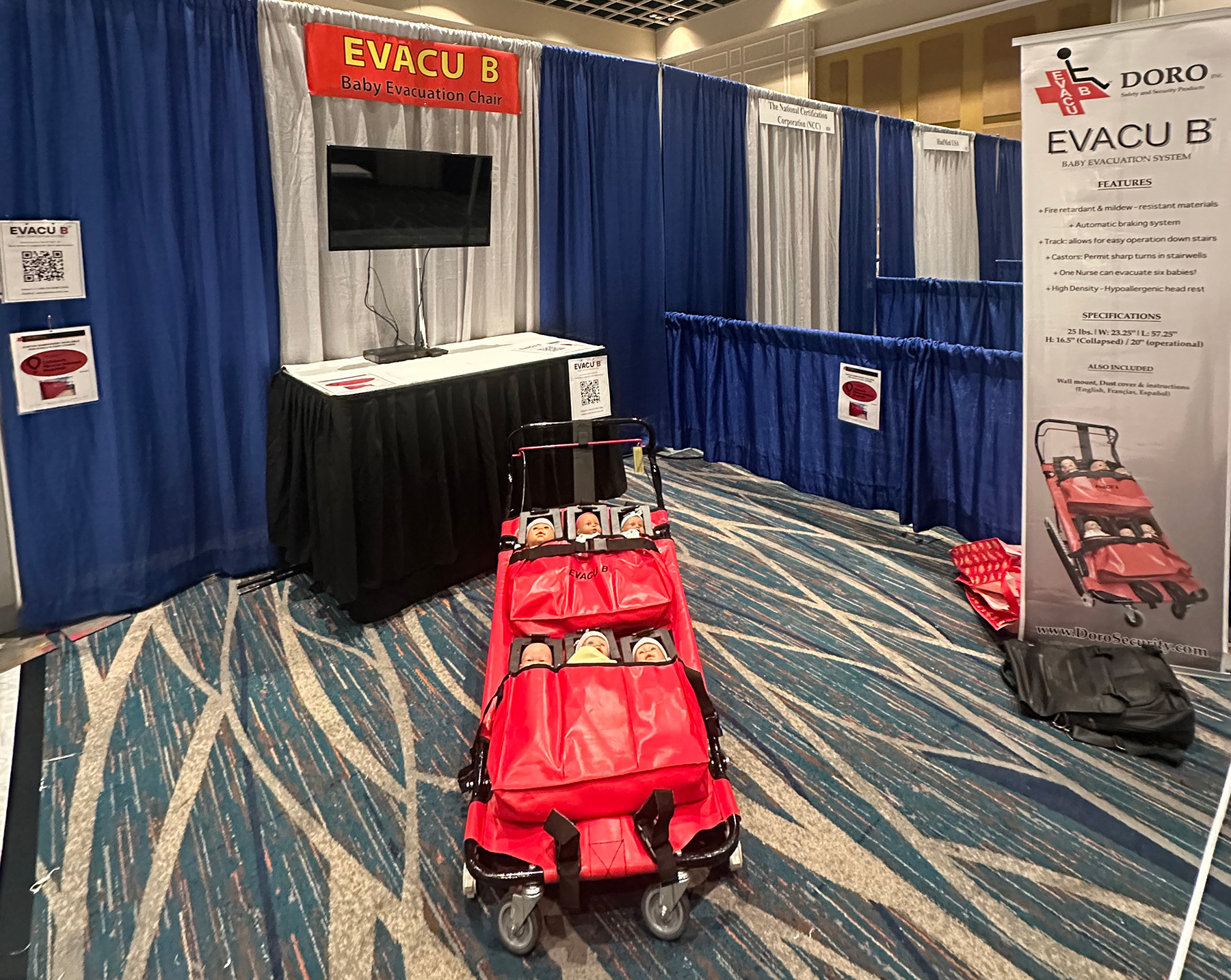
Modern evacuation equipment now makes it possible to meet these regulatory standards efficiently. Purpose-built devices like the Evacu B allow single staff members to transport multiple infants safely, transforming what once required extensive personnel into a manageable process. This advancement helps hospitals align their evacuation capabilities with current safety standards while optimizing resource allocation.
This article provides a framework for developing comprehensive NICU evacuation protocols. We’ll cover planning methodologies, equipment evaluation, training requirements, and vertical evacuation strategies that help safety teams create effective emergency response systems. Each component builds toward a coordinated approach that ensures readiness while maintaining daily operational efficiency.
Understanding NICU-Specific Evacuation Requirements
NICU evacuation protocols must address unique medical and logistical considerations that distinguish these units from other hospital departments. Premature and critically ill infants require continuous monitoring, temperature regulation, and often mechanical ventilation during any movement. Standard patient transport methods don’t account for these specialized needs.
The Joint Commission requires hospitals to demonstrate evacuation capabilities through regular drills and documented procedures. For NICUs, compliance means showing the ability to maintain life support during transport, protect infants from environmental hazards, and complete evacuations within specified timeframes. Meeting these standards requires both appropriate equipment and trained personnel.
Staff-to-patient ratios present a particular planning challenge. While routine NICU care might operate with 1:2 or 1:3 nurse-to-infant ratios, traditional evacuation methods can require 3-4 staff members per infant when carrying babies down stairs with portable equipment. A 40-bed unit would need 120-160 available staff members—an unrealistic expectation during off-hours. This mathematical reality drives the need for equipment solutions that multiply individual staff effectiveness.
Equipment selection directly impacts compliance capabilities. The Evacu B evacuation device addresses these challenges by enabling one trained staff member to transport six infants simultaneously. Each infant rests in an individual compartment rated for 14 pounds, with the entire system featuring automatic braking for controlled stair descent. This six-fold increase in transport capacity brings evacuation staffing requirements within achievable ranges.
Building Your NICU Evacuation Framework
Developing an effective evacuation framework begins with systematic facility assessment. Document your NICU’s physical layout, including all potential evacuation routes, stairwell dimensions, door clearances, and designated assembly areas. Identify potential bottlenecks where standard equipment like isolettes won’t fit through doorways or around corners. This mapping exercise forms the foundation for route planning and equipment positioning.
Create detailed evacuation assignments that specify roles and responsibilities for every shift pattern. Key positions include evacuation coordinator, equipment manager, medical support lead, family liaison, and receiving unit coordinator. Each role needs primary and backup personnel designated across all shifts. Post these assignments prominently and update them monthly to reflect staffing changes.
Documentation systems must function during power outages and system failures. Develop evacuation tags for each infant that include critical information: current weight, gestational age, ventilator settings, medication requirements, and parent contact information. Update these tags at shift changes and store them with evacuation equipment. Maintain grab-and-go binders with copies of essential medical records positioned at NICU exits.
Communication protocols should account for various failure scenarios. Establish clear verbal commands and hand signals for noisy environments. Create laminated reference cards for essential procedures. Designate specific radio channels or communication devices for evacuation coordination. Test these systems during regular drills to identify gaps.
Real-World Applications and Case Studies
The 2012 Hurricane Sandy evacuation at NYU Langone Medical Center demonstrated both challenges and opportunities in NICU evacuation planning. Staff successfully evacuated 20 NICU infants down nine flights of stairs without power, but the process required over 50 staff members and took more than four hours. Staff hand-ventilated babies while carrying them individually—a physically exhausting process that pushed personnel to their limits.
This experience highlighted how proper equipment could have transformed the evacuation. With devices like the Evacu B, the same 20-infant evacuation would have required just 4-5 trained operators making single trips, reducing both time and personnel requirements by 75%. The automatic braking system would have eliminated the physical strain of controlling descent speed while carrying precious cargo.
Cincinnati Children’s Hospital implemented quarterly evacuation drills using specialized equipment and saw measurable improvements. Evacuation completion times decreased by 60% over six months. Staff confidence scores increased from 2.1 to 4.3 on a five-point scale. Most significantly, the hospital reduced its calculated staff requirement for full NICU evacuation from 84 to 14 personnel—bringing emergency response within realistic staffing levels.
Staff Training and Competency Development
Professional development programs must address both equipment operation and evacuation coordination. Initial training should include hands-on practice with evacuation devices during new employee orientation. Allow 45 minutes for staff to practice loading weighted simulation dolls, operating safety features, and navigating stairs. This investment in upfront training pays dividends during actual events.
Quarterly skills sessions maintain competency and identify areas for improvement. Rotate scenarios to cover different evacuation triggers: fire alarm activation, severe weather warnings, and utility failures. Vary drill timing to ensure all shifts participate. Track objective metrics including time to first infant evacuation, total evacuation time, and successful completion of medical support tasks.
Documentation of training completion supports regulatory compliance and identifies gaps in coverage. Maintain training records showing each staff member’s initial certification and quarterly practice sessions. Use skills checklists to verify competency in specific tasks: equipment operation, stairwell navigation, and infant transfer procedures. Share aggregate performance data with staff to maintain engagement and demonstrate improvement.
Vertical Evacuation Strategies for Multi-Story NICUs
Multi-floor facilities require specific strategies for moving infants vertically when elevators become unavailable. Traditional carrying methods pose significant risks: staff fatigue leads to increased fall risk after descending just three flights, and maintaining medical support while navigating stairs challenges even experienced teams. Purpose-built equipment transforms these dynamics.
The Evacu B’s design specifically addresses vertical evacuation challenges. Its automatic braking system maintains controlled descent speed without requiring manual strength. The six-infant capacity means fewer trips and less staff exposure to stairwell hazards. Wide wheels navigate stair treads smoothly, while the low center of gravity prevents tipping.
Establish staging areas every 2-3 floors where staff can rest or transfer infant care responsibilities. Pre-position emergency supplies at these locations: portable oxygen, battery-powered suction, and basic medications. Mark all routes with photoluminescent signage visible during power failures. Designate primary routes for stable infants and wider secondary routes for those requiring additional equipment.
Frequently Asked Questions
What are the Joint Commission timeframes for NICU evacuation?
The Joint Commission expects horizontal evacuation (to an adjacent smoke compartment) within 3 minutes and vertical evacuation completion within 13 minutes for critical care areas. Using specialized equipment like the Evacu B, a 40-bed NICU can achieve full vertical evacuation in under 15 minutes with 7-8 trained operators.
How many evacuation devices does our NICU need?
Calculate one device per 6-8 infants based on your maximum census. A 36-bed NICU typically needs 5-6 Evacu B devices to ensure adequate capacity. Position devices near exits in secured storage that remains accessible during emergencies.
How do we prioritize which infants to evacuate first?
Establish clear triage criteria based on medical stability and support requirements. Generally, evacuate the most stable infants first to clear space, then move to higher-acuity babies with coordinated medical support. The neonatologist or senior NICU nurse makes these determinations based on current patient status.
What’s required for evacuation drill documentation?
Document drill date, time, scenario, participants, evacuation times, and identified improvement opportunities. Include objective metrics: time to evacuate first infant, total evacuation time, and successful equipment deployment. Maintain these records for Joint Commission review.
Conclusion
Comprehensive NICU evacuation planning represents an essential component of hospital emergency preparedness. Meeting regulatory requirements while ensuring infant safety demands specialized equipment, trained personnel, and tested protocols. The evolution from labor-intensive carrying methods to efficient multi-infant transport systems like the Evacu B has made compliance achievable within realistic staffing constraints.
Begin by evaluating your current evacuation capabilities against established standards. Identify gaps in equipment, training frequency, or protocol documentation. Consider how modern evacuation devices could enhance your facility’s readiness while reducing resource requirements. Regular assessment and updates ensure your protocols remain current and effective.
Successful NICU emergency evacuation planning balances regulatory compliance with operational efficiency. Through systematic planning, appropriate equipment selection, and regular training, hospitals can create robust systems that protect their most vulnerable patients while maintaining realistic resource requirements. The result is a program that demonstrates preparedness, supports staff confidence, and ensures readiness for any evacuation scenario.